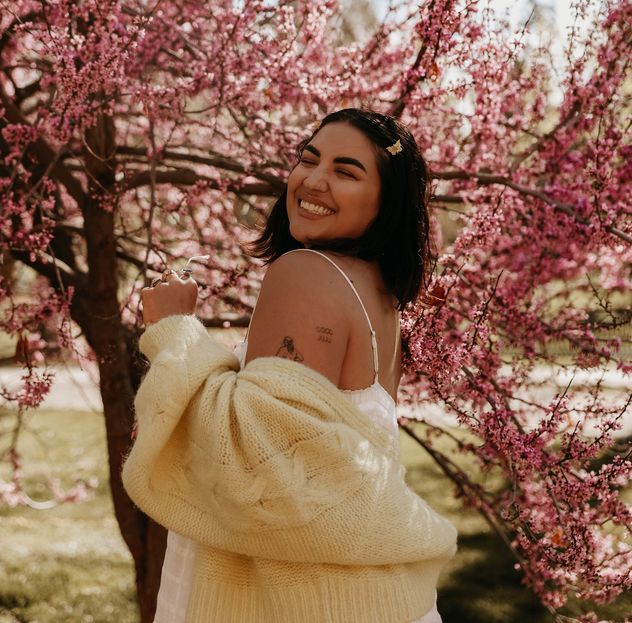
Juju Parzyck:
I remember thinking this is so painful, I almost wish I had my eating disorder to distract me.
Ellie Pike:
It's tempting to think of eating disorder recovery like a nicely packaged someday with clear lines and an undeniable trajectory towards a bright future, a future that leaves your current struggles securely in the past. But what if recovery actually looks less like a confident arrow and more like an uneven spiraling staircase? One where you keep encountering the same atmosphere over your current life as you take each step forward. It may even feel like you're not going anywhere at all, but the truth is you're ascending higher than you ever imagined possible. In today's episode, I'm joined by body image coach and inclusive stylist Juju Parzyck.
Juju Parzyck:
Hi, I'm Juju. I have been in recovery for 10 plus years. I'm a body image and confidence coach, inclusive wardrobe stylist and content creator and I'm all about embracing the body that you have and living life to the fullest.
Ellie Pike:
Juju and I will explore how eating disorders can begin as protective coping mechanisms, how diet culture can disguise disordered eating as normal and what it really means to take step after step in recovery by rebuilding an honest and compassionate relationship with your body, emotions and life. You're listening to Mental Note Podcast. I'm Ellie Pike. So Juju, we're really happy to have you on the show. And before we begin, I want to know if there's anything you want listeners to know about as we talk about eating disorder recovery today.
Juju Parzyck:
I think the biggest thing is just that everybody's journey is their own and maybe my experience may be totally different from somebody else's and just keeping that in mind when talking about recovery.
Ellie Pike:
Thank you for being here and for your honesty. So going back to the early days of your eating disorder that started around, I think you said age 13, would you say that your eating disorder served a purpose? I know that is something that people don't love to talk about, so I'm just going to preface it. I know this is kind of a hot topic. Purpose is interesting.
Juju Parzyck:
Absolutely. That was something that I kind of came to terms with in my recovery and talking with my therapist and dietician was that it served a purpose for a period of time in my life and it did kind of protect me from some things. And then at some point I realized that this is a really maladaptive coping skill, but absolutely it kind of was this secret best friend. It was something that I felt like was mine.
Ellie Pike:
Can you describe what that feels like when you say it was a secret best friend? What did that relationship feel like?
Juju Parzyck:
So I was getting bullied at the time and I was going through puberty and my body was changing and I felt really out of control in my life and it felt like something that was my own, something that I could control. And when I was feeling really inadequate, really embarrassed, just feeling really insecure and struggling with low self-esteem, it was this kind of secret best friend that felt like it was helping me gain confidence. Obviously it was a false sense of confidence and I felt like it was something that I was able to have that felt like I had a grasp on life and I was controlling what was going on externally. And it was something that just... There were other things going on in my life. There was some sexual assaults and it just felt like this safe space for me to go to kind of shut everything else out.
Ellie Pike:
Yeah. And would you say from the outside, were people aware that you were struggling or did it feel like it was this invisible struggle?
Juju Parzyck:
100% an invisible struggle. My parents actually didn't know that I had an eating disorder until I wrote about it in a blog when I was like 23, 24 and they were very, very shocked. There were other eating disorders within my family that were a little bit more visible and a little bit easier to kind of see. And it was something that I very much hid because I didn't want to be a burden to my parents. I didn't want to add more stress to their lives. And so I did a very good job at hiding it and a lot of people had no idea.
Ellie Pike:
Well, and eating disorders are so tricky like that, right? Because oftentimes someone with an eating disorder might be a people pleaser. They don't want to impose anything on anyone else, but it still might be a way to protect oneself. It might be a way to communicate without saying something directly. There's so many functions behind the eating disorder, so it makes sense that no one else would have necessarily noticed.
Juju Parzyck:
100%. Yeah. It was something that I did not want anyone to know about and not even my friends. And it was aware that I struggled with my body image. I was dissatisfied with that, but I don't think anyone had any idea what my relationship kind of really looked like on the inside, especially with food and my body.
Ellie Pike:
Sure. So what led you to an awareness about your eating disorder and then eventually seeking recovery?
Juju Parzyck:
I saw a therapist consistently growing up, but never around my eating disorder. It was something that I honestly wasn't aware of. I knew that I had an eating disorder when I was younger, but at the point from, let's say end of high school into college, I was just what I thought was dieting and being like everyone else. I was just doing what everyone else around me was doing. So I honestly didn't think that I still was in my eating disorder because I wasn't using the behaviors that you would often see when talked about in eating disorder. And so when I sought out a therapist when I was living in LA, I was really struggling with my body image and I was at that time doing the 21-day fix from Beachbody.
And I remember talking to her and filling out the form and talking to her about where I was kind of at and I was like, "Yeah, but I don't really think that I have an eating disorder. I just kind of struggle with body image." And she was like, "Yeah, I would beg to differ." And it was kind of this awakening of all of these things that I had been doing for the last five plus years that I thought was deemed as healthy was actually still very much in my eating disorder.
Ellie Pike:
Well, I think that really highlights just how engrossed eating disorders are in our diet culture and praised for being "healthy", which if anyone's listening, we are not saying that dieting is healthy here and if anything, that that really becomes a way to camouflage what's actually happening internally.
Juju Parzyck:
Yeah. Oh yeah.
Ellie Pike:
So when did you first notice that the eating disorder voice wasn't running the show anymore? Once you started to dig into this idea of, oh wow, maybe I do have an eating disorder and I do have a therapist to help work with me on this piece.
Juju Parzyck:
Yeah. Honestly, I think once I worked with a registered dietician and my therapist on this inner critic eating disorder voice and I was kind of able to let what I call my confident self step in and be the ruler of the conversation, I think the biggest click or switch for me was when I wasn't manually and mentally counting all of the food that I was eating throughout the day. I truly never thought that I would be able to almost unlearn all of the calories in food that I was eating all the time because it was such a behavior that I was doing over the years. And I remember being out to dinner and being like, oh wow, I didn't mentally tally up everything I was eating for the day. And it was this like, oh, I was able to be really present with what I was eating and that was a really big pivotal moment for me where I was like, the eating disorder really isn't kind of ruling my brain on a consistent basis anymore.
Ellie Pike:
I think that that is incredible and obviously such a gradual change that eventually you can start to have this flicker of hope like, wait a second, it's not ruling my every day. It's not taking over all of my thoughts and there is hope. Obviously it's a journey like you mentioned with the spiral. And so leading into the rest of your story, obviously the only constant in life is change and we know that, but you encountered some big traumatic experiences in the last few years. So first, you and your fiance called off your wedding in 2022. Can you walk us through that season and also how did you choose recovery in that process?
Juju Parzyck:
Yeah, that was extremely traumatic. That was something that obviously I didn't plan for and my whole world was rocked and at that point I'm very far into my recovery. I was coming up on like 10 years and I remember there was this moment in thinking, this is so painful I almost wish I had my eating disorder to distract me. It was this feeling of, oh my God, the grief of this feels too much. And there were moments where I was so depressed that I couldn't eat and there were eating disorder thoughts of like, oh, but maybe you could lose weight and you could have a glow up. Or I was like, oh, for me to distract myself, I could download MyFitnessPal and get back into tracking food. There were moments like that where I just felt like the heaviness of it all felt like too much. I wanted to fall back on my old coping skills. And then I realized, no, we don't want to go down that pathway again.
Ellie Pike:
Your old coping skills enabled you to numb or to escape or focus on something besides the actual feeling.
Juju Parzyck:
100%. It felt like it could almost hold the weight of what was going on in life for me. And yeah, I was just like, nope, I've got to sit in the discomfort of this.
Ellie Pike:
And we in this lifetime obviously feel so many emotions and part of the emotions that you were feeling were not just sadness, but grief, deep grief that you lost something that you fully expected to have, which was your marriage and your partner. And in grief, I know in times of grief for me, my appetite changes and to stay in recovery during that process must be really challenging. And so can you speak to that piece a little? Because I think that's a really common instance for anyone going through grief or transitions in life.
Juju Parzyck:
I think there was a part of me that felt a little shameful for even having those thoughts because I was like, God, I'm so far in recovery. How dare I have these thoughts again? And then I had to be like, yo, this is one of the most traumatic things that has ever happened to you. It is only normal that your brain wants to go back to old coping skills that once made you feel numb and once made you feel like the grief and the heaviness of emotions could kind of be lifted. And so I really worked with my therapist at the time of just sitting in the discomfort of what I didn't like and finding other ways to cope and finding other ways to kind of navigate those feelings even though in the back of my head there was this eating disorder chatter. It was like, oh, come back, we could start this all over again.
But I just knew that that path wasn't going to lead me down anything helpful. I've been there before. I knew what that path looked like. And so luckily I was kind of over that bell curve in my recovery where I was like, I don't think I'm going back here, but it definitely was enticing at some moments.
Ellie Pike:
What do you think it would've cost you if you had chosen to go back to your eating disorder?
Juju Parzyck:
Oh my God, everything. It would've cost me all of my healthy relationships with family and friends, everything that I had worked for in my business, my relationship with my body, I feel like everything else around me would've crumbled.
Ellie Pike:
So what do you feel like now that you're not in your eating disorder versus when you did have it? So when you talk about sitting with your emotions, that's not something that you had when you were in your eating disorder. Your eating disorder numbed you out and helped you escape. So what's your experience like now fully feeling?
Juju Parzyck:
It's a lot. I'm a very emotional, sensitive human being and I think for a long time I thought that was a negative thing. I thought that was something that I didn't want to have. And one thing I've really fully accepted is to be human is to feel the full spectrum of emotions and what a beautiful thing that is. And for me to experience grief means I was also able to experience the best thing there is, which is love. And yeah, it can be a little overwhelming sometimes, but isn't that life? It's not this just complete avoidance of all of the things that are heavy. So it definitely can sometimes feel a lot, but it also allows me to actually experience things like joy and happiness fully present.
Ellie Pike:
So when you were numbing those emotions that felt negative to you, like grief, sadness, anger, did you notice it was also numbing those feelings of joy and connection?
Juju Parzyck:
Absolutely. I wasn't able to be present ever. It's so funny when people talk about memories from college and high school and my childhood and so many of my memories are lost because I wasn't fully present. I feel like my memory back then was horrible compared to what it is now just because I don't feel like I was fully there because I was thinking about... I was preoccupied with my eating disorder thoughts.
Ellie Pike:
Well, maybe that's a perfect lead in to... We had a conversation as we were planning this podcast and you shared about how your father had an instance where he was really sick when you were in your eating disorder. And then in more recent years, he also had another bout with his health. And can you share your personal experience of being with him in both of those situations while you were one, in your eating disorder and two, actually in recovery?
Juju Parzyck:
In my early 20s, he got really, really sick and I was studying abroad at the time. I came home and my dad had lost a significant amount of weight and it was really, really scary. He was in the ICU and we were concerned about his life and I remember just feeling really angry. I was really angry. I wasn't really present. I feel like I couldn't really sit with the fear that I was feeling at the moment and I remember just feeling really distant and I actually got into arguments with my parents at the time and fast-forward to, this was the end of last year, I moved home for a period of time and my dad had gone through an amputation and I remember sitting with him in the hospital and I actually helped clean his wounds and spent so much time watching Seinfeld with him and really just connecting with him.
And while I felt deeply, deeply fearful of his life and his health, I felt like I was actually able to be really present with him. And it makes me tear up even thinking about just how much I love my dad. And I think that that was what I was feeling back then that I was so afraid to feel that my eating disorder was kind of like hiding from me was, you really love this man and you really don't want to lose him, and I just kind of avoided that. Whereas this past experience, I really allowed myself to be like, I really love my dad so much and because of that, that's why I'm feeling so fearful. But I was also able to just be really present in the moments with him while he was in the hospital.
Ellie Pike:
I really appreciate you sharing that story because it's so meaningful that you're able to connect the fear with what you actually value and for you it means that you actually value love, like you value that relationship and therefore that's why it's painful and that's why it's so hard. And so to be able to see the flip side of the coin is incredibly meaningful to understand the purpose behind why you're feeling what you're feeling.
Juju Parzyck:
Absolutely. Yeah. It was very overwhelming to be like, oh my gosh, I love my dad this much and how beautiful.
Ellie Pike:
Right, how beautiful and it's not something to run from, but it is something really hard to sit with.
Juju Parzyck:
Absolutely.
Ellie Pike:
So when you talked about really learning different coping mechanisms to use instead of eating disorder behaviors, can you give me some examples of what those are even to this day?
Juju Parzyck:
Yeah. Honestly, I think slowing down for me, I have ADHD and my mind and my body and everything moves a mile a minute and I know that when I'm wanting to feel a little avoidant, I tend to kind of fill my life with things and when I can feel my emotions bubbling up to the surface it honestly just looks like slowing down and sitting and doing deep breathing, going to therapy, spending time outdoors is probably one of the best ways for me to cope with just what's going on in the world to physically touch grass. But I think the biggest thing for me was just slowing down and sitting with my emotions, watching my emotions instead of just getting lost in them.
Ellie Pike:
I think that's incredible. And I imagine, I don't know, you can definitely tell me I'm wrong here, but one of the little things that you might look out for if you're starting to go down a road of like, what if I went back to my eating disorder? One of those things to pay attention to might be avoidance, because it sounds like your way of coping now is to not avoid, to give yourself the space to slow down and actually feel. So if you go too fast and start to avoid those, is that something that you start to notice like, uh-oh, I'm avoiding?
Juju Parzyck:
Absolutely. And it comes out in so many other ways. I'm usually pretty irritable. Yeah, I can tell when I'm feeling avoidant or I'm not wanting to be confrontational or there's something... It's going to find its way out. So usually that means I just need to slow down and be like, what's going on in my brain right now? What am I feeling in my body? And usually it's just honestly asking myself, what do you need right now? I think I avoided that for so long. What does Juju need and how can you take care of her?
Ellie Pike:
I think that that's really beautiful. When you feel like your eating disorder voice is getting louder and louder, like for example, during a transition or a breakup or a family crisis, what do you wish that our listeners knew who might be in the same situation?
Juju Parzyck:
What would've been helpful for me is this is so normal. If you had an eating disorder for a really long time like myself for 10 plus years and that was your way of coping, it is only natural that during a big crisis when something traumatic happens that that voice might try to kind of slither its way in and to one, know that that's not shameful and to talk about it, to be vocal about it, to talk to your support team or system about those feelings that are coming up and to really just know that that's kind of part of recovery. There was part of me that was like, I'm past this, this shouldn't be happening.
And I really just had to give myself a lot of grace and compassion for that season that I was in and knowing, hey, this is just part of being human and you've overcome something that a lot of people struggle to overcome and this is only natural that your brain is going to come back to those spaces to try and feel safe, but you're safe, you're okay. And sometimes we need to go back to the basics when it comes to recovery. And that's kind of what I needed to do.
Ellie Pike:
I feel like you're coming full circle back to what you said at the beginning is your story is unique. Everyone's story is unique. And I appreciate though that there's this commonality. Yes, you're normal. It's okay that you're having these thoughts. That's really normal. Nothing is wrong with you because you're having these thoughts. Your brain is just trying to survive. And there's also support, whether that's therapy or treatment or working with a dietician or free support groups, right? There are tools that folks can access. And so we will certainly link to our support groups in the show notes so that everyone has a free resource they can tap into. And I think what's so unique about those support groups is just knowing that it's not a unique situation to struggle and that's okay. We can do it together and we can support each other. So my last question for you, Juju, is what does choosing recovery look like today? Not once but daily. What is your daily rhythm that keeps you in recovery?
Juju Parzyck:
I think the biggest thing is one, nourishing myself. I know that usually my anxiety or my depression is coming at play if I'm not nourishing myself. And so that's always a baseline. You have to feed yourself and really just allowing myself to sit with what I'm feeling in that moment and asking myself daily like, what do you need today? How can you support yourself today? And knowing that every single day is going to look different. And I think just really knowing that life is going to throw some curveballs at you. And I think for me, the biggest thing during those seasons is just leaning on the people that love you and support you because that's the best way for me to get through those times.
Ellie Pike:
Thank you, Juju. This has just been so lovely and wonderful. And so if folks want to follow along with you, how can they be in touch or see what you're up to?
Juju Parzyck:
Yeah, my Instagram is Fitfat And All That. My website is fitfatandallthat.com and you can email me at fitfatandallthat@gmail.com as well.
Ellie Pike:
I think what I love most about Juju's story is that she invites us to rethink recovery, not as perfection, but as a return to presence again and again. And for those listening, if you heard parts of your own experience reflected in this conversation, you're not alone. Support is out there. If you'd like to connect with Juju, you can find her on Instagram at Fitfat And All That. Also, this episode's show notes link to numerous free support groups at Eating Recovery Center and Pathlight Mood and Anxiety Center. As always, thank you for being here and for being part of these conversations. Mental Note is brought to you by Eating Recovery Center and Pathlight Mood and Anxiety Center. If you'd like to talk to a trained therapist to see if in person virtual treatment or a relapse prevention program is right for you, please call them at 877-850-7199.
If you need a free support group, check out eatingrecovery.com/support-groups or pathlightbh.com/support-groups. Also, could you do us a quick favor? Leave a glowing review for us on iTunes, Spotify, or wherever you're listening. Sign up for our e-newsletter and learn more about the people we interview at mentalnotepodcast.com. Doing these things really helps our show grow and we are so grateful for your effort. MentalNote is produced and hosted by me, Ellie Pike, edited by Carrie Daniels and directed by Sam Pike. Until next time.